
April 7, 2025 · Fair Oaks Ranch Concrete
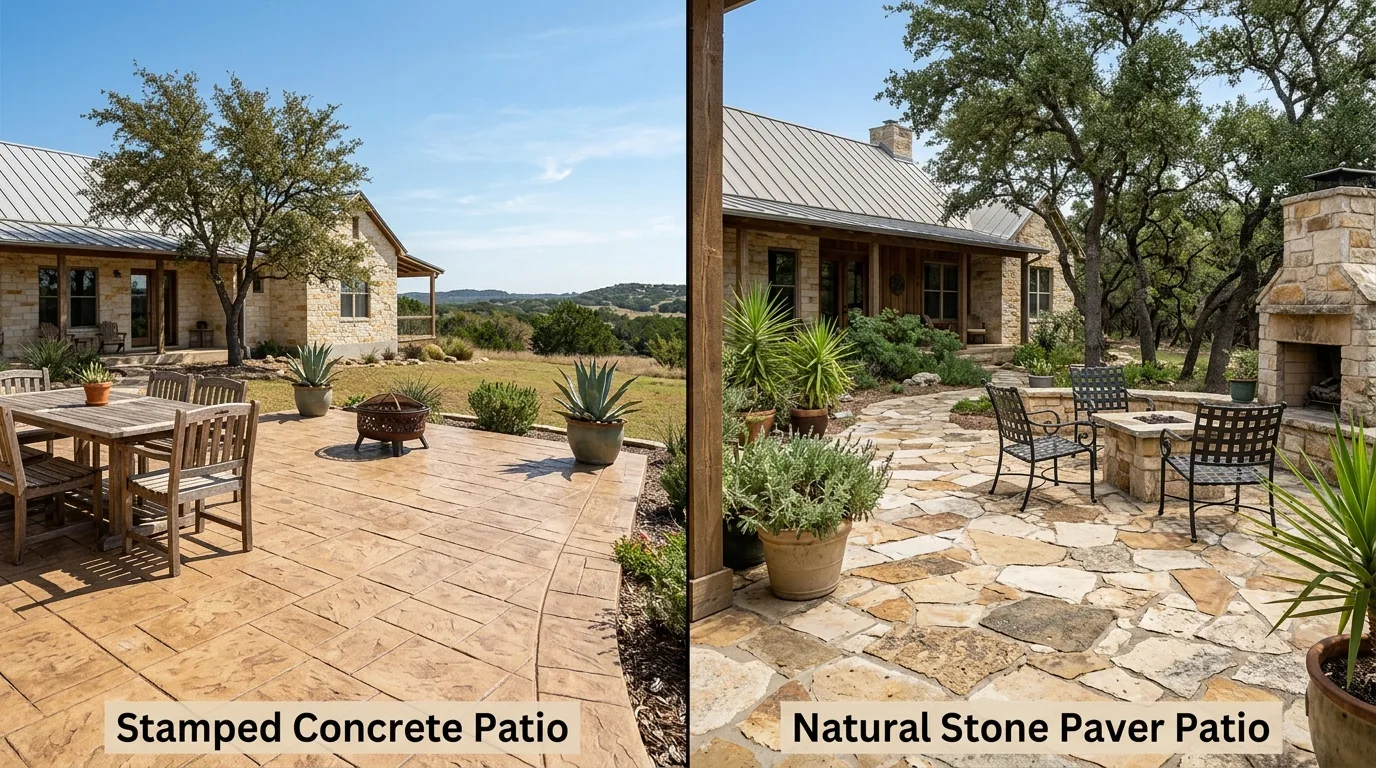
Stamped Concrete vs. Pavers: Which Is Better for Texas Hill Country?
Comparing stamped concrete and pavers for driveways, patios, and pool decks in the Texas Hill Country. Cost, durability, maintenance, and local considerations.
If you’re designing a new patio, driveway, or pool deck in Fair Oaks Ranch or the Texas Hill Country, two options consistently rise to the top of the list: stamped concrete and pavers. Both look great. Both are durable. But they perform very differently in our specific climate — and one almost always wins.
Side-by-Side Comparison
| Factor | Stamped Concrete | Pavers |
|---|---|---|
| Upfront cost | $12–$22/sq ft | $15–$30+/sq ft |
| Lifespan | 25–40 years | 25–50 years (individual units last longer) |
| Maintenance | Low (reseal every 2–3 yrs) | Medium (joint sand, weed control, resetting) |
| Repair | Difficult to match exactly | Easy — replace individual units |
| Weed intrusion | None | Joints can allow weeds |
| Ant/pest intrusion | None | Joints can harbor ants |
| Clay soil performance | Good with proper base | Excellent — flexible system |
| Visual options | Very wide | Very wide |
| Resale value | Good | Excellent |
The Clay Soil Factor
Here’s the most important local consideration: Texas Hill Country clay soils move. A lot. This is where pavers have a legitimate engineering advantage.
Pavers are an interlocking system — individual units sit on a compacted sand and gravel base, and they can flex slightly with soil movement without cracking. When a section settles, you can often reset the individual pavers without removing the entire installation.
Concrete is a rigid monolithic slab. When properly installed with a good base, control joints, and fiber reinforcement, it handles clay soil movement very well. But if the base preparation is poor, it will crack — and repairing a crack in stamped concrete is difficult to match perfectly.
Bottom line: Both work in Hill Country clay soils. The difference is in execution. With a reputable contractor who does proper base work, stamped concrete performs just as well as pavers.
Cost Comparison Over Time
Pavers have a higher upfront cost but individual unit replacement is cheap. Stamped concrete costs less initially and requires primarily just resealing. Over a 30-year period, costs are relatively comparable.
Where stamped concrete wins on total cost is when you account for the labor advantage during installation — a single crew can pour and finish a large patio in 1–2 days; pavers require significantly more hand-placed installation time, which drives up labor costs.
Maintenance Reality in Texas
Stamped Concrete Maintenance
- Reseal every 2–3 years (~$0.25–$0.60/sq ft professionally applied)
- Promptly clean oil, grease, and stains before they penetrate
- Fill any cracks that develop with color-matched sealant
Paver Maintenance
- Add polymeric joint sand every few years as it erodes
- Control weeds in joints (can be significant in our climate)
- Reset any individual pavers that heave or settle
- Reseal occasionally if desired (for enhanced color and stain resistance)
In Texas, the weed issue in paver joints is real. Our climate provides ideal conditions for weeds in any unprotected joint. Polymeric jointing sand helps significantly but isn’t a permanent solution.
Our Recommendation
For most applications in Fair Oaks Ranch and the Hill Country:
- Patios: Either is excellent. Choose based on your aesthetic preference and budget.
- Driveways: Stamped concrete generally wins on cost-effectiveness and durability under vehicle loading.
- Pool decks: Stamped concrete with exposed aggregate or a low-sheen travertine stamp is the most popular and practical choice.
- Walkways: Pavers work beautifully for garden paths; concrete is more practical for high-use walkways.
Ready to Start Your Project?
Contact Fair Oaks Ranch Concrete for a free, no-obligation estimate. We serve all of the Texas Hill Country.